 |
| https://pantmonger.artstation.com/projects/GnBAz |
So.
Dungeons and Dragons is a game, or a set of games, or the idea of a genre of game where you roll dice and pretend to be a wizard or a thief or a paladin or something in fantastical locations meeting classic monsters like goblins and mimics and dragons. There can be plots, you can be on a dungeon crawl or a railroad or a sandbox. When I talk about RPG's, I mostly refer to games like this. They have different names, like Pathfinder, Old School Essentials, or Worlds Without Number; but I'm talking about games with a distinct fixation on the simulated realities of the characters in them. You can call these games DnD-likes, if you absolutely have to.
Material Conditions refer to a person's, well, material conditions. The conditions of their material reality. Do you have a car? What is your house like? Do you have enough food for the week? Can you walk? People have needs which dictate their behavior, and they have Material Conditions that determine how and if those needs are met. I subscribe to the idea that human history is best understood through a study of Material Conditions and the Labor involved in them. History is a record of the tools humanity has used to meet their needs- the logistics of feeding, clothing, and housing people. I think that understanding how people meet their needs through the tools and environment available to them is crucial to an understanding of humanity. Culture, history, politics, these things stem from Material Conditions. This is called Historical Materialism.
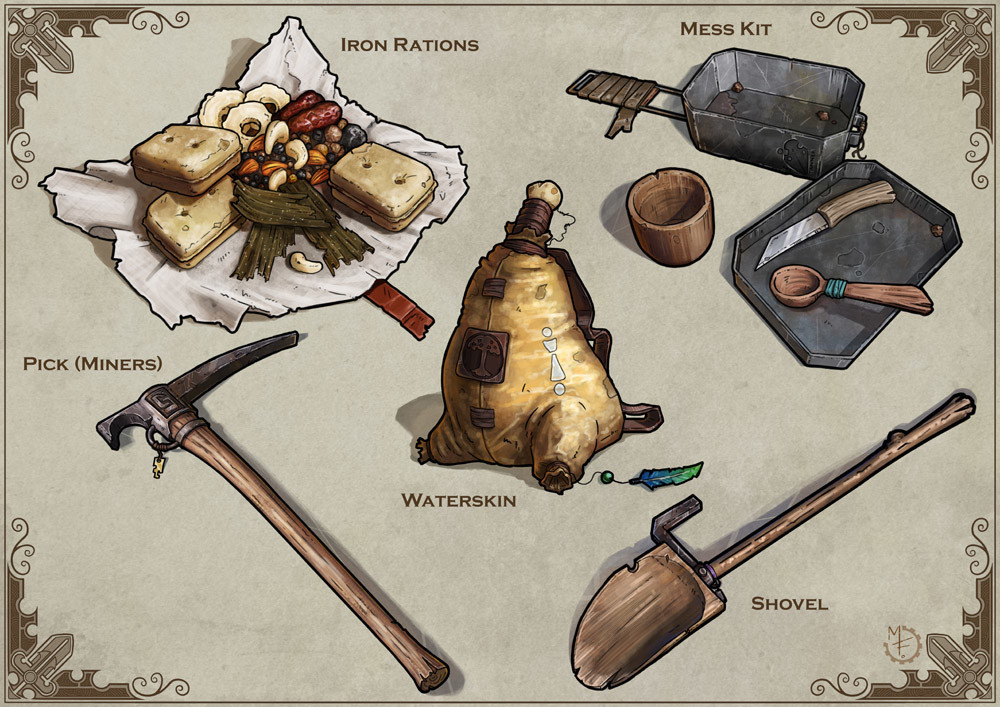
This understanding of Material Conditions can, obviously, be translated to Dungeon Type games. Do you have a lockpick? Do you have a torch or a lantern? How large is your inventory? Do you have enough hirelings and wagons to carry that Dragon's Hoard?
DnD-like games in particular are obsessed with Material Conditions. Even 5th edition, whose case I will get on in a bit, has a surplus of tables and rules and resources pertaining to encumbrance. It cares about how much stuff you can bring with you into a dungeon, it cares about the prices of chickens and cows and wagons. Hell, there's a table that lists the volumetric capacity of jugs, waterskins, barrels, and tankards separately.
I characterized this type of game as a "Equipment Table" type game; where you track the number of coins in your purse in a specialized
spot on your sheet and have to make sure that you packed lunch before
going into a forest to hit things with your sword- which also needs to
be typographically specified from a list of swords with different
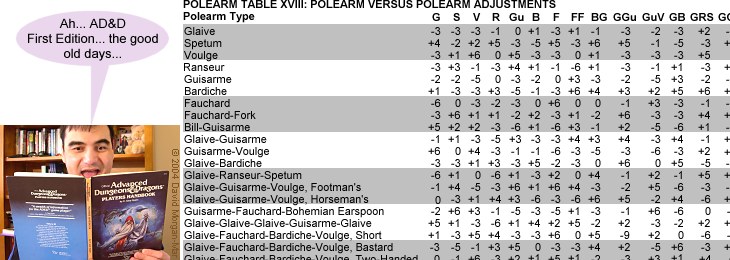
mechanical characteristics based on its length. 5e has tridents, pikes, javelins and spears, all different weapons with different stats! This isn't just about weapon types, it's about granular distinctions of even apparently minor changes in the Material Conditions in the game world.
 |
| https://www.irregularwebcomic.net/543.html |
Monsters are differentiated even further, sometimes to the point of absurdity. Goblins, Gnomes, Redcaps, Boggarts, Boggles, and a dozen other creatures with the same folkloric origin but different names have entirely different stat blocks.
5e lists monsters like Hobgoblins and Orcs down to the last stat point- even though realistically you should only really need one "Humanoid with Weapon" monster statblock. And... I agree. Something in me recoils at the thought of not having separate stat blocks for different monsters, that one "just use bears" article viscerally repulsed me when I read it. A Human being is not a Hobgoblin- they need different stat blocks, even if nobody except me would ever know.
I know a lot of people who frown when presented with a system that elides these material conditions in favor of Narrative solutions. Dungeon World doesn't make characters track inventory items; they can pop open their backpack and pull out a rope or torch or something at any point in the adventure up to a certain number of times. They hated that! Those same people want their character sheet to contain an exact amount of gold pieces and torches and waterskins. They spend time before the game looking through the equipment table picking out these items. They care about them. And I'm one of them! The Equipment table is exactly what drew me to these types of games to begin with. When I was too young to really understand the game or find a group to play with, I'd imagine play scenarios while reading equipment tables, imagining how I would use all the different strange little bits of adventuring gear when I played. My first few games I was basically a point and click character, constantly picking up random crap and trying to use it to solve puzzles, greasing hinges and trying to feed animals poisoned bait.
Then I learned that the material conditions sold to you by these games are fake.
The games include these things- but that does not always reflect their importance to the game itself. The existence of the volumetric capacity table in 5e doesn't mean the designers care about how much liquid random containers can contain, they were just cargo-culting based off of the neurotic table-obsession of Gary Gygax! Tridents and pikes are in there because half of Advanced Dungeons and Dragons' weapons table was different polearms. Those things are in there because they were in ADnD and 4e was a huge failure and they needed to try and recapture that old-school magic so they just went rifling through old editions' pockets. News flash, nobody uses encumbrance! The age of the material condition has ended; the culture of play that lives upon 5e does not care about tracking lamp oil or caltrops or the exact differences between a glaive-guisarme, glaive, guisarme, and voulge-guisarme. They do not care about Material Conditions. There are fake equipment table type games and there are real ones- and the problem is that nobody even knows that these are two different genres. Maybe not even the designers.
For a brief period I thought that the equipment lists themselves were the problem. I was dissatisfied with games that didn't feel connected to the fictional reality. I didn't like that spells like Prestidigitation and Light made torches and tinderboxes useless.
This led to my spiral into the compromise, Daggerheart and Dungeon World and Pathfinder 2e. These games retain the aesthetics of materialism without the bite. Weapons are largely interchangeable props, not distinguished by their physical characteristics, but by attached gamist or narrative principles. Your character can use a Scythe as a weapon for god's sake!! They're stat sticks with microfeats baked into them! You wear armor, not because it stops daggers and arrows, but because it has "aura!" I found myself even more deeply unsatisfied by these games. You could do anything, be any kind of character, but that was simply because none of those choices mattered. Every character ended up being equally useful because every character was equally disconnected from material conditions. I didn't have to puzzle out scenarios in which my character's items and skills could be useful, because the games are tilted in such a way that basically the only things worth doing are shooting monsters in the face- something every character class and ability has been very delicately balanced around so that there are no real wrong choices.
(I actually think that these games are fun and well designed in general- but part of a genre that I do not care for.)
I could slot Narrative, Simulationist, and Gamist games into a neat continuum. Simulationist games are the most invested into material conditions, while Gamist games are only interested in the aesthetic of them. Narrative games are wholly uninterested in material conditions- or at the very least just the bare minimum required for action scenes. I'm not sure that's wholly productive though. Most games aren't strictly separable into that neat typology.
So, why am I ranting about this? What is so important to me about Material Conditions? Well... I have a lot more to say, but this post is getting a long and I don't even know if it's a useful lens of analysis. Am I saying important things or just navel gazing? I think losing sight of material conditions leads to a loss of something essentially captivating about Dungeon type games; explaining the gradual loss of identity the "official" DnD game line has suffered- including the tragedy of the Martial/Caster divide and combat bloat. More on that later, I guess.

No comments:
Post a Comment