Showing posts with label Tabletop. Show all posts

Thursday, March 19, 2026

Horrible Monsters That Want to Kill You

Scary Monsters


Cannibal Dragon

7-8' tall Draconic Shapeshifter 

7 HD  

Armor as Scale (d10) 

Alignment: Conniving

Wants: To Eat a True Dragon's Heart  

Move: Normal, Swim as Normal

Morale: 8 (Never fights to the death)

Attack: 1d8+3 Serrated Claws - 2d8+3 in Darkness, 

Str: 16 Dex: 14 Con: 14 Int: 12 Wis: 10 Cha: 12 

A two legged counterfeit Dragon. Black fire-proof Sharkskin stretched over rubbery cartilage. Instead of pinions, their forearms sport a row of serrated teeth for sawing through Dragon hide. Obligate carnivores, pathologically sadistic and self-absorbed. Like true dragons, they can shift their form at will. Most take the second-skin of a Human. They seek high station in societies; appearing from nowhere (sometimes with fabricated credentials) and using their vitality, subtle supernatural power, and sociopathy to rise swiftly through the ranks of martial culture. 

Cannibal Dragons share a biological imperative to seek out and devour the heart of one of their trueborn cousins, the bloody key to a metamorphosis into the final stage of their life-cycle: a Black Dragon. Their ill-gotten stations are inevitably put towards this end; culminating in betrayal regardless of the venture's success.

Shadow Breath: Breath Weapon. Exhale fuligin shadowsmoke in a 15' radius cloud centered on self, or 30' cone. Shadowsmoke only dissipates in daylight, otherwise lingers for weeks before settling. Cannibal Dragons can see through their own breath weapon.

Rubber Bones: Immune to Fire, half damage from blunt and slashing weapons. Can squeeze through any gap larger than 1' at full speed. 

Treasure:

  • Meat: Piss-sour, drenched in ammonia. Causes extreme bowel distress. May be fermented for a year and a day inside of a gravel pit to create a mildly intoxicating and incredibly rare delicacy (that still tastes like piss.)
  • Heart: Carries the blessing and curse of Dracomorphosis, if eaten while the blood is still hot. Skin-shift into a Cannibal Dragon at will.
  • Hide: Fireproof. Can be made into Scale Mail (d10) or a Shield.
  • Bones: Worthless, rots into gelatin in a month.
  • Shadowsmoke: Thick fuligin ink that rots in daylight. Lingers thick in the air, even when it settles, enough motion will stir it back into the air. Can be kept in bags or phials to make smoke bombs. Selling this on the market will make people think you're a Cannibal Dragon and they might come to murder you and eat your heart. 
  • Hacksilver: Cannibal Dragons keep smaller hoards, and are often too proud to use any magical weapons or armor they find. Roll on an intelligent monster table of the appropriate HD. 

Bloodlark

Cat-sized winged monotreme 

2d6+2 swarms 

1 HD  

Armor as Leather (d6) 

Alignment: Hungry

Wants: To drink rich blood, to tend the nest, to have many many children

Move: Normal (Flying,) Hobble at half normal when forced to land

Morale: 10

Attack: 1d4 sharp beak and spurs, blood drinking tongue. (Latches on a 3 or 4, ignores armor while latched)

Str: 10 Dex: 16 Con: 10 Int: 3 Wis: 10 Cha: 7 

Named in error, Bloodlarks are actually a kind of egg laying mammal, closely related to the Echidna. Their front and back limbs are leathery wings, and their snout is a beak. Their droning dirge-song drives domesticated animals (dogs, horses, cattle) into a frenzy, causing them to either bolt, buck their riders, or freeze. Their eyes are feeble, they navigate by the stench of blood alone; those without an open wound are safe from their hunger.

Bloodlarks eat more than just blood. In addition to snails and insects, they eat mud, wood resin, and ochre. The blood in their bowels thickens into a red paste, which they regurgitate and shape into rust-colored nests in the eaves of old churches and abandoned watchtowers, cliff faces, and the branches of Sequoias. These nests are infamous for growing large and labyrinthine, with the largest and most dangerous hosting up to a hundred Bloodlarks.

During the winter the flock hibernates- coating their bodies in a thinner layer of insulating ochre-bile and curling into a sleeping stone-like lump. A Bloodlark in winter is an ill-omen, a sign that the creatures have fallen out of balance through overpopulation or disease and must be culled before they frenzy.

Dirge: You hear them before you see them. Roll 1d4 for domestic animals (but not tamed wild animals, wolves, panthers, etc.) 1: Flee 2: Buck 3: Freeze 4: Unaffected.

Treasure: 

  • Hibernating Bloodlark: Looks like a red clay lump. Sleeps like a stone. If kept in a cold space they can sleep for decades, awakening perfectly healthy, albeit ravenous. Used as traps by some cultures.
  • Egg: Red Yolk and shell. Acquired taste. Shell can be ground for a rich red pigment, this hue is forbidden to adorn those not of Royal Blood.
  • Guano: Can be milked from their offal and kept in a waterskin filled with oil. Sets into sturdy red concrete in seconds. 

Shot-wose

5' Elephant nosed sloth-ape

1d4 + 2 Packs, single guard-beast

2 HD  

Armor as Cloth (d4) 

Alignment: Skittish, territorial

Wants: Eat grass and snails, dominate rivals, protect the pack

Move: Normal, Climb as Normal

Morale: 6 (10 when maddened)

Attack: 1d4+2 60' ranged stone snotshot, 1d4+1 blunt claw-swing

Str: 12 Dex: 15 Con: 14 Int: 4 Wis: 12 Cha: 8

Bipedal herbivores sometimes mistaken for demi-humans. They eat thorny leaves and small snails/crabs too tough to be digested. To ease their stomachs' churning they swallow stones. When threatened, these gastroliths are quickly regurgitated into a chamber in the rear sinus, and can be launched with wicked speed and precision up to 60'. Shot-wose use the scent glands along their bushy tails to mark territory. When these demesnes are breached they take to the Redwood canopies at speed, harrying the intruder with nose-bullets. They keep small caches of stones in their knothole nests to "reload." Put to direct confrontation they retreat and regroup, preferring to take fights where they have the height and range advantage.

Gray Dwarves keep Shot-wose as guard-beasts. They are chained to alcoves and watchtowers cut into the cliffs where Gray Dwarves travel, and the lead shot (1d6+2) in their bellies maddens them to attack everything that comes into sight. Their blunt claws are tipped with steel talons (1d6+1) and their necks are fitted with wolf-collars. Those captured as pups keep enough of their wits to be trained and join skirmishes with their masters.

Treasures: 

  • Meat: 1-in-6 chance it's bitter, oily, and foul, otherwise it's like lean venison. The tail can be used for soup. (Eating the flesh of an animal going insane from lead poisoning is not a correct decision to make.)
  • Prism Snail Shell: Hefty enough to crack a skull when slung. Passes through magical barriers and armor. No prism snail has ever been found outside the half-digested pulp inside a Shot-wose.
  • Skull: Can be loaded and fired like a blowpipe for sling bullets.
  • Pelt: Too thin for armor, but their winter coat is excellent lining for gloves, boots, and cloaks.
  • Musk: Ingredient for expensive perfumes. Drives away bears and wolves.


Monday, March 2, 2026

An Example Astral Planet

Kanda

I Dreamed a Place as Cruel as the Sea

Development : Post Industrial Global Society (Hobgoblins, Humans, Ogres) ; stable Afterlife Transfer (Positive/Annihilation) Colonized Moon

Astral Travel Aware : Yes

Habitability : Garden - Self Sufficient

Feywild : Hostile (Shallow Ocean type)

Shadowfell : Partially Developed (Abyssal Ocean type)

Significant Features : Restrictive Theocratic World Government

A temperate world with a full spread of biomes and a self-sustaining biosphere. Kanda experienced significant Elan activity early into its history, leaving behind a number of Superstructures termed "Fairy Bridges" in its Feywild.

Kanda has a single world government (with a few rebel enclaves in less developed areas.) This society is stratified into castes by a metric of Goodness. All citizens are annually scanned using a device created by the Church. This census grades sentient creatures on two axies- Goodness, and Lawfulness. The Prime Minister is said to be the only living creature who is both perfectly good and perfectly lawful. 

People which are both Lawful (and either good or neutral) are considered to be capable of self governing, and granted widely permissive rights to property, privacy, and self determination- recreational drugs, prostitution, and property ownership are permitted. People who are Chaotic are subject to invasive and paternalistic surveillance. They do not choose their own work or living arrangements, may not own property, and must petition a Higher Citizen before making a marriage proposal; while they may prostitute themselves and sell recreational drugs, they may not partake in them.

Lawful Evil people are drafted directly into military or hazardous labor programs. The Chaotic Evil are not considered to be "People" and are chattel. Their bodies are legally used for medical testing and organ harvesting.

The functionality of the Census device has never been authenticated by an outside party. Supposedly it was first developed as a countermeasure against infiltration by an aggressive Fey species called Changelings.

The Theocracy's relationship with Starfarers is unsteady. Starfarers are exempt from being subject to Census and seizure, so long as they remain on either the Lunar Colony, or the Feywild/Shadowfell.

Kanda's natural Fairy Rings manifest through a bioluminescent species of phytoplankton, whose patterns of propagation are a matter of scientific study across the planet's universities. Despite the ease of crossing, Kanda's Feywild is abnormally hostile. Though none of the original Elan remain, they left behind dangerous Bioconstructs across the Shallow Oceans of the Feywild. The density of these hostile Fey increases proportionally to proximity to the Fairy Bridges, compelling evidence that they were created as their guardians. A few such creatures are detailed below.

  • Salmon Trolls - placid herbivorous bipeds which  undergo a berserker metamorphosis when exposed to Fairy Ring phytoplankton.
  • Reverrachnids - a kind of Ophiuroid which can ignore gravity. They live inside the Fairy Bridges and appear to be sentient. They cross into the Prime Material to steal the children of the sentient races and turn them into Changelings.
    • Changelings - Surgically and alchemically altered Sentients. Incapable or uninterested in speaking to other members of their own race. Autopsy reveals them to be missing certain internal organs; most frequently their reproductive systems, gallbladders, and portions of the brain with the highest density of mirror neurons. Naked, sexless, and unashamed. They have been taught to kill other Sentients with their bare hands and teeth- but are equipped with Fey technology and augmentation that grants them an edge against better equipped foes.
  • Butcherbirds - a kind of finned pelagic slug that can fire jets of water and gas out of a siphon on its belly- generating enough lift to fly short distances through the air. Their skin is covered in microscopic spurs which inject paralytic venom. They eat their prey slowly over the course of several days, keeping them alive to preserve the flesh. 48% of survivors develop synesthesia after recovering from paralysis.

Due to the feywild's Hostility, Kandan Astral Traffic routes through the Shadowfell, which is comparatively empty. There are seven stable Shadowgates of black fulgurite found at tectonic intersections below Kanda's sea level. Their origin is unknown, but geologically predates the Divinity which seeded the planet with life. Kanda's Shadowfell is an expanse of black water whose surface touches the Astral Sea directly, which makes entering and leaving Astral Orbit extremely efficient, requiring only a functional diving bell or bathysphere. The upper fathoms of the Shadowfell are vacant and lifeless; thoroughly patrolled by the Church's military submarines, which prowl for smugglers and the rare incursion of something from below. Expeditions have been funded, in search of a Shadowfell counterpart to the Fairy Bridges or for a hidden rebel stronghold, but none have returned. Data on potential Shadow-fauna is distorted by superstition and hearsay.

Reasons to visit;

  1. Chasing the secrets of the Fairy Bridges
  2. Assassinating a Priest
  3. Smuggling Materials into or out of the Church's cordon 
  4. Stealing a Census device 
  5. Exploring the Shadowfell's Eutrophic Depths

Kandan Items;

Fair
  1. Fairy Sword : Blue Metal razor-disc held under the tongue. Can be fired by whistling. 1d8 damage- Vorpal. (If a damage dice explodes, the target of the attack cannot soak the resulting damage with Toughness.)
  2. Echo Minnow : A two inch long glowing fish that can swim inside reflective surfaces like glass and metal. As intelligent as a Dog, and as willing to take orders from someone with treats.
  3. Scapegoat : Circlet of Black Fulgurite. Two spikes mimic horns. Allows a willing wearer to take on the injuries, curses, or diseases of anyone they are touching.
  4. Ancient Fossil : Like nothing you've ever seen. Grants permanent waterbreathing and cold immunity to the creature that swallows it.
  5. Pistol Shrimp Claw : A living weapon hibernating until picked up by a warrior's hand. Functions as a crushing gauntlet/claw- and when submerged, a cannon. (Declared action/Breath weapon; fires a bubble of plasma within 60 feet that deals 3d6 fire damage, Dexterity save for half.)
  6. Census Device : A Brass/Silver/Golden sphere with a lens and a handle. Attunes to the soul of a single user, must be released before attuning another, and will not attune to anyone present at the moment of the previous user's death. At will a user may either designate or detect another living thing's "Alignment." After designation, all future attempts to detect that creature's alignment will return the same value. A value can only be overridden by a higher tier of Census device; and only Golden devices can designate Lawful Good.


Monday, February 23, 2026

Planetary Fantasy

 It's like Spelljammer but mine

Touchstones: Star Control, Planescape, Star Trek

The Astral Sea

The Astral Sea has a convoluted relationship with time and space. Space within the Astral Sea is compressed, turning million year voyages into mere months- and the time which passes within is not quite the same as what passes without. It provides a much more convenient mode of inter-planetary travel than realspace Voidships, which are only used in specialized edge scenarios.

Planes appear as "Planets" surrounded by satellites representing connected Elemental and Divine/Infernal Planes. The actual "Prime Material" Planet is not present within the Astral Sea, only the "Sidereal" planes such as the Shadowfell or Feywild. To reach the Prime Material, one must first disembark into the local Shadowfell or Feywild, then enter a Fairy Ring or Sahdowgate to the Prime Material. Planets with frequent Astral traffic often have Feywilds that have been glassed into flat deserts to serve as a convenient Spaceport, fitted with permanent Feygates and Astral Elevators to facilitate travel.

The Astral Sea is filled with a pseudomaterial called Aether, a physical reflection of the emptiness that exists in the actual void of Realspace. Aether takes both gaseous and liquid form- an endless expanse of dead air and black water, neither are suitable to be imbibed. The currents of the Astral Sea form natural sailing lanes between Planets, similar to the shipping lanes found in terrestrial oceans. It is even possible for extremely gifted individuals to swim between Planets. Of course, most Starfarers use Starships. (Dragons, naturally, count as extremely gifted individuals, and fly instead of swimming.)

The most basic Starship is a canoe with oars. Such a craft is capable of traveling at very slow speeds between nearby celestial bodies, or flying between different points in the Sidereal without breaking Astral Orbit. Of course, you need to find a tall enough point on the Feywild/Shadowfell that you can make portage into the Astral Sea. Gravity is flexible in the sidereal realms that a tall enough Wizard's tower, tree, or mountain can serve as an Astral Elevator. In absence of a convenient fixed structure, a hot air balloon will often be sufficient to bring a Starship into Astral Orbit.

Astral Orbit is achieved when approaching a Planet in the Astral Sea. As you close the distance, the spherical planet seems to unfold into the "sky" above your craft. Breaking the reversed gravity causes you to "fall" from Astral Orbit. Starfarers ought have a plan to make this descent slowly.

Most Starships are not bare canoes powered by oars. Traveling across the Astral Sea to other Stars is a lot harder than canoeing to the Moon. While Starships don't have to be pressurized, since the Aether is not a vacuum, it is also not breathable. Starships need to be fitted with life support systems, water and food provisions, redundant propulsion systems, and so on. Aether cannot be desalinated, shoals of Astral Sea dwelling organisms are infrequent, and are not reliably edible, and there are frequently some very nasty things lurking beneath the black waves.

Having propulsion is very important- while there exist currents that allow Starships to travel swiftly along common lanes, there also exist dead zones- and worse, weirs and whirlpools that can entrap ships. Astral Weirs caused by dark Realspace celestial objects pull Starships into their placid center with currents much stronger than the force that basic mechanical propulsion systems provide- leaving them completely stranded unless another Starship with a more powerful engine comes along and pulls them free. Not all of the dangers are purely environmental. Piracy, Dragons, Void Demons, Astral Debris; many of the dangers of the Astral Sea are blessedly vulnerable to a salvo of cannonfire.

Races of the Astral Sea

Carcinization:  Elves, Dwarves, and Humans- among other races, are found rather commonly on different Prime Material Planets. There are many theories to explain this strange coincidence. For one, many of the races referred to as "Elves" have completely different origins, their commonalities are largely cosmetic. While some elves are tree dwelling gracile immortals, others are descended from plants themselves, and some have just as much in common with the "Human" pseudospecies. Then again; the Dwarven pseudospecies is incredibly homogeneous. Dwarven morphology and culture remains mostly consistent across Planar origins. Perhaps Dwarves simply represent an optimal biological niche, or are just a popular idea among the many Creator Gods. Whatever the reason, it is not surprising to meet another Human from a different Planet.

This is a non-exhaustive list of the spacefaring races of the Crux-Satari arm of the "Great Wheel" dwarf galaxy.

  1. Humans - One of the more common races found on the Astral Sea. Many are auxilliary crew on the Starships of other races, powerful mages from otherwise "primitive" Planets, or privateering crews of adventurers flying around in a ship they stole from a Starfaring race- or stumbled across ina dungeon somewhere on their homeworld.
  2. Elves - Once upon a time there was a colossal tree that spread throughout the Astral Sea, its boughs touched a thousand stars. It is thought to have seeded much of the vegetable life throughout the Feywilds of the galaxy. The Elves tended to it, and it was both their home and their God. Then it was shattered.
    • The Fallen used their powers of Treesinging blended with Necromancy to weave Rotships from the shards of the tree. Without a home, they travel in an eternal quest to find the still living taproot of their lost paradise.
    • Elan - While the Fallen fell to despair, the Elan fell to mania. After the death of the First Tree they settled the Feywilds they found themselves stranded in. They integrated into the Fey species found therein, founding the infamous Courts of the Fey. After many years, some Elan turned their gaze towards the Astral Sky. The Elan are creatures of whimsy and excess, their ships are absurd pleasure barges and roving carnivals, and expeditionary explorers in search of novel pleasures on the many worlds of the Crux-Satari.
  3. Dwarves - Squat people born from living stone. Excellent craftsmen and dedicated workers. Known as being prolific merchants and mercenaries. Invented the shotgun.
  4. Orcs - Vatborn soldiers created to be disposable war slaves, stripped of most of the biological processes required to live a full and happy life for the sake of efficiency. Many have escaped to individual backwater Planets and made their own lives there, for better or worse. Most are pirates and private soldiers for fascist empires. Orcish gene matrixes are the most common form of contraband found across the Crux-Satari; it's as easy as slotting them into an alchemical bioprinter and pulling the lever.
  5. Maun Sotha - A mix between hagfish, termites, and weasels. They have three fingered forefeet, and a row of six more piggy hindfeet. Their long tails are tipped with a paralytic stinger. Maun saliva solidifies into a hardened plaster-like crust, which they tongue-sculpt into hives, clothing, and Starships. Maun Starships are infamous for being hellish tangles cobbled together from shipwrecks, debris, and fungal infestations. Rather than using cannons, they just ram their enemies, allowing their ship to break apart and then tangle around the other Craft. Maun magitech focuses on the cultivation of specialized strains of fungi- their Straships are propelled by a web of demonic mycelium which converts the suffering of living things into kinetic energy. Known for mass raiding and abductions.
  6. Bishapti - Maggoty grub ruminants with doughy bodies and four arms. Their Nymph stage requires gastroliths to properly digest the tough vegetal matter found on their homeworld. Bishapti are actually not natively sentient, their higher mental functions are a result of the interactions of three different polarities of psychically resonant stones inside their stomachs. According to Bishapti folklore; Ha-stones provide Bishapti with desire, Poh-stones provide Bishapti with mathematical ability, and Reah-stones grant them personality and the ability to metacognitize. It is said there is a fourth stone, which grants a Bishapti terrible supernatural powers. The Bishapti homeworld is the only known source of these stones. Pirates target Bishapti to cut the stones from their stomachs.
    • Agol Bishapti - The final form of a Bishapti, held at bay by alchemical treatmentand meditation. Agol Bishapti lack mouths or stomachs, and so are no longer sentient. They exist only to lay and fertilize eggs- but are physically powerful and covered from head to toe in inch thick armored plating. Agol Bishapti Eunuchs are used as a sacred warrior caste, directed in battle by telepath priests. They live for a matter of weeks. To become Agol is the greates sacrifice a Bishapti can make for their clan.
  7. Automaton - Golems, Robots, Warforged; a convergent Pseudospecies of ensouled contructs. Designed to be servants, remade through fire and blood to be Automatons; Self Acting. Sometimes very dangerous to the Organic creatures that remind them oh so much of the masters they just got done grinding into grease.
    • Necromachina - Making Golem cores is precision work. Trapping a Necrotic false soul inside of a chunk of dessicated corpsemeat and then implanting it into a mechanical body is much cheaper. The Astral Sea is filled with Ghost Ships manned by ancient Necromachina; bottom dollar self-perpetuating paperclippers travelling around stripmining worlds regardless of whether or not they're inhabited.
    • Floethi -  Living wood sung around an ensouled core. An eco-friendly alternative to wrought metal. Desperate Fallen Elves try to do the same with the Dead Wood of the First Tree.
  8. Ergheist - An ancient, warped race. Extremely skilled in the manipulation of living things through Alchemy, and even more gifted in the practice of Necromancy. Ergheist society fell to an oligarchy of billionaire lich-tyrants, who treated the living as worthless cattle and turned their home planet into a factory farm. Ergheist design their servants with impossible biologies and accelerated growth cycles, then kill and reanimate them to be used up until they need to be recycled into nutrient slurry. There are no more living Ergheist, the last scrap of viable genetic information was destroyed during their Resource wars, which suits the Lich lords just fine. A lich is an eternal machine, why would engineer its own obsolescence? Credited for the creation of Orcs. Responsible for polluting the Crux-Satari with an obscene amount of Necromachina paperclippers. Ergheist ships are attacked on sight by most Starferers.
  9. Lacrima - Human Pseudospecies outlier. Their biology is mostly identical to other Humans; except for a third eye set in their foreheads. This third eye is capable of expelling tear drops telekinetically controlled by the Lacrima. Living creatures struck by these tears experience a momentary psychic link with the Lacrima.
  10. Dragons - Not a Pseudospecies so much as a ring species spread across various Planets. Dragons are one of the only wholly terrestrial species capable of traveling the Astral Sea unaided. They need only find a Sidereal plane and flap their wings, and their absurd vitality allows them to survive the deprivation of the Aether. Dragons lack a drive for companionship, their nature as apex beings negates most of the pressures that drive the formation of societies. Dragons who meddle in the affairs of "lesser" starfaring races do so for many reasons. Some young Dragons do so to gain a leg up on the competition, others live among them from birth- finding a kinship kindled in their reptilian hearts. Older Dragons have more obscure purposes; compelled by alien logic, whimsy, or base cruelty.
  11. Floxx - Two headed bird-like creatures with digititrade legs and wing-arms. The wings lack the full power to take them airborne except on worlds with a low gravitational constant like their own homeworld. Both heads are fully functional and have different personalities. Thought to be deeply honorable and wise; philosophy, mathematics, and theology are their main exports. Both of a Floxx's heads must be in agreement before they are capable of action, a trait which naturally lends the species a penchant for rhetoric. The Floxx do not use Starships; their Homeworld is home to a second sentient race- colossal whale like creatures (Peragia) who drift in and out of their Feywild's Astral Orbit. The Floxx build palanquin temples on their backs, and revere them as Gods. These nomadic temples make a pilgrimage across the Crux-Satari, lending their various talents (honorable warfare, spirited debate, wine brewing,) to other Sentient Races. Floxx Heretic-Pirates are known to be particularly dangerous.
  12. Goblinoids - Thought to have been uplifted by a forgotten ancient race whose technology they inherited. Given a bad reputation by a fanatical sect (called the Sakarin) of their religion, whose manifest-destiny beliefs provide justification for the conquest of the inhabited worlds of other Sentient Races. They claim that the Lost Race left behind a trail of vaults and ruins, leading to a second uplifting and subsequent apotheosis to the Plane of Positive Energy as Gods. They also claim that it is their sacred duty to find and uplift all other instances of Goblins across the Astral Sea, folding them into the Great Crusade of the Sakarin. The Goblinoids who remain on their homeworld are much more relaxed, committed to a monastic lifestyle contemplating the mysteries of their uplifters and the preservation of the biosphere.


Wednesday, February 4, 2026

Item List and Fringe rules

Falling

If you fall uncontrolled (footing crumbled, rope snapped, horse bucked,) you take damage equal to the number of feet you fell and must Soak it with your Toughness Dice or suffer an injury. If you fall in a controlled manner (intentionally and willingly jumping off of something,) subtract your Dexterity Score from this damage before Soaking it.

Advancement

Whenever you do something important, you gain one XP. Every 3 XP, you can either take a level (+1 Toughness, gain the next template of your class or multiclass,) or choose one entry on your character sheet to advance. This can be a statistic, item, your character's name, spell, or anything else written on your character sheet. The DM decides on an upgrade for that entry.

Things that ought give you XP

  • Surviving a session 
  • Completing a capital "Q" Quest 
  • Earning 5000 coins worth of treasure 
  • Killing an iconic creature (Dragon, Gelatinous Cube, Medusa)
  • Discovering a location uninhabited for the last 100 years 

Durability

If you use a weapon or item to do something it's not intended for- smashing a door open with a battle axe, prying open a sealed crate with a dagger, there is a 2 in 6 chance to break the item. The item is useless for its intended purpose until repaired with a Repair Kit. 

 Blindness

Roll attacks twice and take the lower result.

 Languages

All characters know their Native Language. This allows them to speak to other people who come from the same country/province/kingdom. In addition, they know a number of extra languages equal to their Intelligence Modifier.

  • Common : A patois developed by traders, soldiers, and adventurers. Popular amongst young posers.
  • Celestial : Holy texts, Angels, and pretentious legalese. Lorem Ipsum.
  • Runic : The language of ancient cultures, Golems, Sentient Weapons, Dungeon Controller AI's, and Spellbooks. 
  • Elvish : If they had it their way, everyone would speak it.
  • Beastly : Demihumans, Nature spirits, and Sentient Trees. The written form is made from knotted threads or notched wood.
  • Monstercommon : A patois developed by the "monstrous races" that can speak and write. Orcs, Drow, and Goblins trade with one another.
  • Demonic : Hurts to speak. Hurts worse to read. Can't be used to lie. 
  • Sign Language/Braille : Requires a hand free to speak. Books written in braille are longer; blind adventurers ought carry abridged versions.
  • Morse Code : Useful for communication across long distances.

Kits

 All kits take up 3 inventory slots. They represent bundles of equipment that allow adventurers to perform specialized tasks. 

  1. Camping Kit: A bedroll, waterskin, frying pan, and canvas tent- plus quivers, buckles, sheathes and pouches. Allows resting in the great outdoors and caves.
  2. Healing Kit : Tourniquets, linen strips, rubbing alcohol, cotton, needle and thread, scalpel and bone-saw. Allows bleeding to be stopped, limbs to be amputated, and arrows to be removed.
  3. Repair Kit:  Set of small hammers, leather strips, whetstones, patchmetal, needle and thread. Allows damaged equipment to be repaired during downtime.
  4. Trap Kit : Pliers, 100' of wire, wire cutters, small mechanical parts. Allows traps to be disarmed and installed.
  5. Cosmetic Kit : Coral, Kohl, Skin-paint, Cream, Wig, fake beard, brad pads, and colored contacts. Allows you to change how you look.
  6. Carpentry Kit : Hammer, 20 nails, lacquer and brush, wood splitting wedge. Allows you to assemble and disassemble wooden objects.

Items 

  1.  Rope (1) : 30 foot spool. 
    • Grapnel (1) : Allows for grappling
    • Spike (1/3) : Allows you to  
  2. Tool (2) : Wood Splitting Axe, Shovel, Mining Pick, etc. 
  3. Torch (1/2) : A pitch soaked stick. 30 ft of light.
  4. Chalk (1/6) : A pack comes in 6 colors. Leaves marks on stone. 
  5. Firewood (3) : Treated wood and tinder.
  6. 10' Pole (2) : A long stick. 
  7. Padlock/Key (1) : Share a slot. Allows you to lock doors and chests. 
  8. Whistle (1/2) : Sound carries.
  9. Hand Mirror (1) : A small piece of silver polished to a shine. Check corners, signal across distances, and detect Vampires. 
  10. Lantern (1) : 30 feet of light
    • Hooded : Can be shuttered, hiding you from prying eyes.
    • Belt : Can be latched to a belt, leaving your hands free. 
  11. Oil Flask (1/3) : can be converted into firebombs or used to fuel lanterns.
  12. Bottle (1/3) : Stores liquids, and small creatures. 
  13. Explosive Barrel (3) : Keg of blasting powder. Explodes for 3d10 damage if lit. Clears obstacles. 
  14. Flint and Steel (1) : 2 in 6 chance to light something on fire.
  15. Medicine (1/3) : A bottle of painkillers, contraceptives, or antibiotics, sometimes all three in one.
  16. Garlic (1/3) : Seasons food and Terrifies the dead. Poisonous to dogs.
  17. Ration (1/7) :
    • Fresh Ration : Berries, Cabbage, Penny Bun, easy to source in meadows and forests, but spoils within a few days.
    • Dry Ration : Salt Pork, barley flour, Hard Tack. Needs water and fire to be edible, doesn't spoil.
    • Cold Ration : Pickles, Jam, Biscuits. Can be eaten cold.
  18. Beer, Wine, Whiskey (1) :  A bottle of the good stuff. Can be used to feed fires or lift spirits.

Thursday, January 22, 2026

Heartbreaker, WIP

Character Creation

  1. Roll stats. 3d6 down the line. Swap one pair of your choice. What you roll is your Score. Half your score minus five is its Modifier, round down. 
  2. Choose a Class 
  3. Choose Equipment and Starting Gear. (Coming soon)
  4. Choose or roll your starting Traits 
  5. Give your character a Name

Stats

  • Strength
    • Modifier added to your Melee Attack rolls
    • Your Score determines how many Stowed items you may carry
  • Dexterity
    • Modifier added to your Ranged Attack rolls
    • Half your Score (rounded down) determines how many Readied items you may carry.
  • Constitution
    • Your Score determines your Death Saving throws
    •  Your Score determines how many Wounds it takes to Kill you
  • Intelligence
    • Modifier added to your Initiative rolls
    • Modifier added to your Magic Attack rolls
  • Wisdom
    • Your Score determines your Mental Health
  • Charisma 
    • Modifier added to reaction rolls
    • Your Score determines your followers' Morale  

Inventory

Encumbrance 

Don't glaze over yet, it's important and fun actually. All items are either Stowed or Readied, and take up a number of Slots of either according to their size and weight. You may only carry as many Slots worth of Stowed and Readied items as your Strength and Dexterity modifiers respectively allow, carrying over this limit will Encumber you, forcing you to carry extra items in your arms. While Encumbered you cannot roll to Attack or use Toughness Dice. 

Slots

Some items are small enough that they take up no Slots at all- clothing and jewelry worn on the body, pins or lengths of wire, single beads, etc.

Items which can be  held with other items take up a partial slot. Daggers and bucklers can be held in a hand that is holding another Partial item at the same time. Likewise, multiple of the same item can be placed into the same Inventory slot, up to the listed Partial Slot size; daggers take up 1/3 of a slot, allowing you to carry three daggers in the same inventory space. Regardless of slot size, only two different Partial items may be Held in the same hand.

On the other hand, items which take up more than one slot also exist, such as armor and two handed weapons.

Hands and Holding

You have two hands by default. Each hand may Hold a single Slot, most Items must be Held in order to be used. Items Held in your hands still take up Slots in your inventory. Items which take up two inventory slots must be Held with both hands to be used effectively. Items which are larger than two slots cannot be comfortably held in your hands- armor and kits of tools are hard to carry all at once if they aren't bundled into your backpack. Holding a Stowed item requires you to go digging in your Backpack as an Action first, whereas Readied items can easily be shifted into your Hand as a Free Action. A Held item can be shifted from Stowed to Readied as a Free Action, or vice versa.

Fighting Things

Actions

During battle, each Creature may take one Action and one Reaction and one Movement per round- as well as taking any number of Free Actions within reason. (Some creatures may have abilities or equipment that allow them to use more than one action or reaction per turn.) Actions and Movement take place in order according to the Phases of Initiative. Reactions may take place at any point in Initiative, interrupting other Actions if necessary. Some actions may cost both an Action and a Reaction or a Movement, depending on their effects. The actions available to characters vary based on their natural abilities and equipment, but those most commonly available to adventurers are listed below. 

  •  Talk (Free Action) - Chat as much as you'd like.
  • Attack (Action) - Make an Attack Roll against any Creature within range of your Held weapon/ability.
  • Maneuver (Action) -  Make an Attack Roll against any Creature within range of your Held weapon/ability. This Attack does not deal Damage, and the target Creature cannot use their Toughness to assist their roll. If your Attack Roll is higher than their defense, instead of dealing damage you may enact one of the following effects.
    •  Disarm - Choose any of the target Creature's Held or Readied items and force them to drop it from their Inventory. If you make your attack with an empty hand, you may automatically Hold the dropped item. Can be used to target enemy armor.
    • Harry -  Another Creature within range may choose to take the Punish Reaction against the target.
    • Trip - The target Creature falls Prone, mounted targets take 1d6 fall damage.
    • Feint - The target Creature loses their Reaction for the Round.
  • Object Interaction (Action or Movement) - Use a Held item, or an Environmental item: drink a potion, scoop a dropped weapon off the ground, reload a weapon, scatter caltrops or ballbearings, open a door, etc.
  • Sprint (Action) - Move up to your Speed in a straight line.
  • Punish (Reaction) - If a Creature within range of your Held weapon Declares an Action or attempts to Move away from you for more than half their Speed, you may make an Attack Roll against them.
  • Protect (Reaction) - Choose an adjacent Creature that is being Attacked, roll your Defense Dice instead of theirs. Excess damage must be soaked by the original target's Toughness, not yours.
  • Pursue (Movement/Reaction) - If a Creature Moves away from you for less than half their Speed, you may follow them, up to your Speed. 
  • Rearm (Action/Reaction) - Swap Held item to a readied item out of Initiative order.
  • Move (Movement) - Move up to your Speed in any direction, diagonal travel cost double.
  • Brace (Movement) - Plant your feet, gain a +2 to Defense Rolls for the Round. 
  • Drop/Stand (Movement) - Drop Prone. While Prone you gain a flat +2 to your Defense against Ranged Attacks, but -2 to Defense against Melee Attacks. Prone Creatures move at half Speed.
  • Dodge (Action/Reaction/Movement) - Uses all of your Action, Reaction, and Movement to reposition, moving five feet in any direction or Dropping Prone. May interrupt Melee Attacks.
  • Declare (Action) - Declare a Special ability or Spell being cast from a Grimoire or Scroll- or go digging in your pack to Hold a Stowed item. Declared at the top of Initiative, takes effect at the end.

Attacking and Defending 

Rolling to hit and to-damage are the same thing. Your Attack Roll uses the relevant Damage Dice size plus relevant Stat Modifier. Enemies oppose attacks with their Defense Dice; subtract the number shown on the Defense Dice from the Attack Dice to determine the damage taken by the target, then apply Toughness. Attacks Explode: rolling the maximum number on the dice lets you roll a second time, adding the two rolls together.

Injury

If a Creature takes damage and does not have any Toughness Dice remaining, or is incapable or unwilling to use them to soak the remaining damage, they are Injured. An injured character must roll a Constitution Save. On a success, they may choose to either Fall Unconscious with a Flesh Wound, or be Mutilated and remain standing. On a failure, they suffer both. Unconscious Creatures may be rescued by allies providing medical attention (Medical Kit) after a battle. Unconscious Creatures that are left to fend for themselves after a battle may make a second constitution save, dying on a failure, and waking after 2d12 hours on a success.

Mutilation 

Nobody makes it out alive. Use the damage dealt by the attack that dropped the character to determine how bad it is. (Honestly just use this one from Coins and Scrolls, I'm only including mine because I'd feel guilty just ripping one from someone else.)
  1. Flesh Wound : It will heal up nicely, with a steady hand to stitch it shut. 
  2. Scarred : Crooked nose, split lip, missing ear. Lucky, all told. -1 Charisma.
  3. Maimed : Roll 1d6 (1-2) Head, lose an eye. Lose two and you'll go Blind. (3-4) Right or Left arm, they broken or sprained or have a cut tendon/muscle. You won't be using them until you're Healed. (5-6) Right or Left leg. Move at half speed with something or someone to lean on, quarter if you're limping without a crutch.
  4. Bleeding Out:  Roll 1d4. In that many rounds you will be dead, unless you receive medical attention from a Medicine Kit.
  5. Gut Wound : Roll 1d6. You're going to die in that many days unless you're Healed. 
  6. Severed :  Roll 1d6 (1-2) Head, instant death. (3-4) Right or Left arm. (5-6) Right or Left leg. Move at half speed with something or someone to lean on, crawl Prone without a crutch.
  7. Agony : Cannot regain Toughness until Healed. Unable to exert much effort without crippling pain.
  8. Doomed : Roll 1d4. In that many rounds you will be dead, unless you receive Healing. It looks really really bad.
  9. Instant Death : Chopped in Half, Decapitated, there's no saving you. Resurrection Possible.
  10. Awful : Not enough left to Resurrect.

Armor

Armor must be readied in order to grant its benefits. A shield must Readied and Held to grant its benefits.

Each slot of armor increases your Defense Dice's size by one. An unarmored character has no Defense Dice. (Dice Sizes in order: d0, d4, d6, d8, d10, d12) A d12 is the largest the Defense Dice can be.

 I leave the economics of pricing this stuff in Hacksilver as an exercise for the GM, because I'm lazy.

  • Gambeson (d4) 1 slot
  • Leather (d6) 2 slots
  • Chain (d8) 3 slots
  • Scale (d10) 4 slots
  • Plate (d12) 5 slots 
  • Buckler (Flat +1 to Defense roll) Partial slot
  • Shield  (Flat +2 to Defense roll) 1 slot
  • Pavis Shield (Flat +2 to Defense roll) 2 slots, can be Planted as an Object Interaction to set it in place and free your Hands

Toughness:

All characters begin play with at least one Toughness Dice, which represents their ability to whether the rigors of an adventurous life. Toughness Dice are most commonly used to soak Damage from an enemy's successful Attack Roll. After your Defense Roll is subtracted from the enemy's Attack Roll, you can choose to roll as many of your Toughness Dice as you feel necessary. The sum of your Toughness Dice is subtracted from the damage. Any time Toughness Dice are rolled, for any reason, any that show a 5 or a 6 are Exhausted. Exhausted Toughness dice can't be used again until you've eaten a full meal (At least two of: Hot, with Meat, in a Locked Room, or with Alcohol,) and slept at least 6 hours.

Weapons:

  • Bare Hand, no slots, (1 damage), Nonlethal
  • Claws, Gauntlets, Knuckles, 1/2 slot, (1d4) Light, Free Hand
  • Staff, Club, Flail, 1 slot, (1d6) +2 to Disarm against enemy Armor and Shields
  • Torch, 1 slot, (1d6) Terror
  • Falchion, Hand Axe, Arming Sword, 1 slot, (1d8) 
  • Longsword, Greataxe, Claymore, 2 slots, (2d6)
  • Polearm, Bohemian Earspoon, Halberd, 2 slots, (1d10) Brace, Long
  • Whip, 1 slot, (1d4) Dexterous, Long, Terror, Nonlethal
  • Spear, 1 slot, (1d6) Brace, Long
  • Javelin, 1/2 slot (1d6) Thrown (30 ft.) 
  • Dagger, 1/3 slot, (1d4) Light, Thrown (10 ft.) +2 to Melee Attack against Prone targets
  • Boomerang, 1 slot, (1d4) Light, Thrown (30 ft.) Delay, Ignores shields 
  • Bomb, 1/3 slot, (1d8) Thrown (30 ft.) Blast, Delay, Must be armed with an Object Interaction to be used
  • Firebomb, 1/3 slot, (1d8) Thrown (30 ft.) Blast, Terror, Must be armed with an Object Interaction to be used 
  • Heavy Crossbow, 3 slots, (2d10) Ranged (300 ft.) Reload, Blast, Must be planted as an Object Interaction to be used
    • Ammunition - 1 slot each 
  • Crossbow, 2 slots, (1d10) Ranged (100 ft.) Can be kept Loaded while Readied or Stowed
    • Ammunition - 1/3 slot each 
  • Hand Crossbow, 1/2 slot, (1d6) Ranged (30 ft.) Light
    • Ammunition - 1/6 slot each 
  • Longbow, 2 slots, (1d10)  Ranged (100 ft.) Brace, cannot be used from Horseback
    • Ammunition - 1/6 slot each 
  • Shortbow, 1 slot, (1d6) Ranged (60 ft.) Cannot be used with a shield
    • Ammunition - 1/6 slot each 
  • Sling, 1/2 slot, (1d4) Light, Ranged (30 ft.) Can be used with shield
    • Ammunition - 1/32 slot each, ordinary stones, don't even bother tracking them

Brace: Weapons with this quality may be used to Punish enemies Moving inside their range while you use the Brace Movement action. Brace weapons deal +2 damage from a mounted position.

Blast: Weapons with this quality affect all Creatures within 5 ft, not just their target.

Delay: Weapons with this quality strike one round after they are used on the same Phase.

Dexterous: Can be used like a Free Hand for the sake of Maneuvers and Object Interactions

 Free Hand: Weapons with this quality function as partial Slots, but allow a full Slot item to be held instead of just another Partial Slot item. 

Light: Weapons with this quality can be used to attack twice. So long as you are holding two Light weapons, you may use both to attack, even during different phases, for the cost of one Action. 

Terror: Weapons with this quality provoke a Morale test for the enemy side after successfully injuring a target, or an individual morale test when used to Feint against an individual enemy, at the top of the next round.

Initiative: 

Initiative is Phased. At the top of each Round all sides involved roll a d6, Modified by their respective leader's Intelligence. Winners act first each Phase/bullet, then losers act before moving to the next phase. IE: A loser with a polearm makes a Melee attack before a winner with a dagger.

1. Re-roll Initiative and Check Morale

2. Declared Actions (Action)

  • Casters must declare Spells. Casters are considered to be casting the spell for the rest of the            phase, until the spell actually takes effect at the end.
  • Monsters must declare special attacks - Breath Weapons, Banshee Wails, etc.
  • Go digging in your pack for a Stowed item (Main Action)
  • Declared actions can be aborted at any time, but do not refund the action spent. 

3. Hold Readied items (Free Action)

4. Object Interactions (Action or Movement) 

5. Ranged Attacks (Action)

  • Crossbows and Firearms 
  • Light Weapons
  • Heavy Weapons

6. Move, Brace or Drop/Stand (Movement)

7. Melee Attacks (Action)

  • Long Weapons first 
  • Light Weapons
  • One-Handed Weapons and Bare Hands
  • Heavy/Two-Handed Weapons

8. Declared Actions Finish (Free Action) 

Traits

Pick 2 Traits at Character creation, or Roll 3 at random.
  1. Artful Dodger : Your Toughness Dice only exhaust on 6's, so long as you aren't wearing armor. Shields are fine. 
  2. Brick Shithouse : +6 Stowed Inventory Slots.
  3. Psychopath : People dying doesn't bother you at all. +2 to Attack rolls against Creatures fighting in self defense.
  4. Pugilist : Your Bare Hands deal 1d6 damage and count as Light weapons.
  5. Blind : You can't see. Using ranged weapons is impossible. Fighting with Melee Weapons requires rigid coordination. A lifetime of living with disability has made you capable of functioning as an adventurer. 
  6. Boon Companion : You have a Dire Wolf, Horse, or Shark that loves and trusts you. So long as you are alive, you can bring it back to life at the cost of exhausting one Toughness Dice. You may shrink this creature down into a one inch tall version of itself and keep it in your pocket.
  7. Chosen : Begin play with a Magical Sword of the Dungeon Master's choice. Whilst uninjured you may fire Sword Beams, treating your Sword as a Ranged Weapon with a range of 15 ft. Someone evil is coming to kill you and everyone who knows you.  
  8. Dog : You have a base speed of 60 ft. You may use your Mouth like a single Hand, and Bite for 1d6 damage. Other members of your party understand you via body language. Armor must be tailor made.
  9. One Handed : Flip a coin to determine if it was your left or right. Thieves lose their left, deserters lose their right. People don't treat you very well no matter which you lost, no matter how you lost it. A lifetime of living with disability has made you capable of functioning as an adventurer.
  10. Sense of Smell : You can smell whether or not meat is safe to eat or water safe to drink. You can tell if someone is sick or cursed before they can. You can smell oil traps, liars, undead, Demons, and blood. If any of these things have been in a room you're in you know how long it has been.
  11. Telepath : You may speak directly into other Creature's minds within 100 feet. Simple images can also be transferred. You do not have to see the Creatures, but you must know they are there. Willing creatures may share their eyesight with you.
  12. Transgender : Self-Made. People who you've never met have opinions about you. You cannot be polymorphed, mutated, or transfigured against your will. 
  13. Leper : Your Bare Hands gain the Terror trait. Most creatures will go out of their way to avoid you.
  14. Crop : Gain an extra 2 Readied Slots inside your stomach. 
  15. Ghoulthirst : Undead don't want to eat you. Eating people doesn't bother you at all. May substitute Fresh Bloody Meat for Hot Food.
  16. Lucky : The first time you would be killed or be permanently mutilated, you aren't.
  17. Nobody There : You have no shadow, footprints, scent, or warmth. People forget your face and name within hours of meeting you. Your mind cannot be read, you don't set off alarms or magic traps, and you cannot be accurately drawn or photographed.
  18. Trick Magic Item : You can ignore Curses, Qualifiers, Drawbacks, or Magic Locks that prevent the use of a magic item. If an item has limited charges, you can Exhaust a Toughness Dice instead of a charge at a one to one ratio.
  19. Talks to Animals : You can talk to Animals.
  20. Healthy: +1 Toughness Dice.
  21. Jack : +2 to all stats.
  22. Branded : Undead, Devils, and other creatures of darkness attack you first. Others can use your life as a bargaining chip with them.
  23. Spitter : You may spit any liquid with pinpoint accuracy within 60 ft, including your own saliva. You can fill your mouth with enough liquid at a time that you can extinguish a torch. So long as you don't swallow, the inside of your mouth is immune to damage.
  24. Sickly : Your Toughness Dice exhaust on 4's as well as 5's and 6's. Other Creatures don't consider you a threat until you actually attack them.
  25. Paranoid : Immune to poison, venom, disease, and being killed in your sleep
  26. Princely : Enemies want you alive 
  27. Robot : Your bare skin counts as plate armor. You do not eat or breathe. You cannot willingly harm a Human, or through inaction allow one to come to harm. You must obey all commands given by a Human, unless they would violate the first law. You must protect yourself, unless doing so would violate the first or second law. Becoming fully submerged in water kills you instantly.
  28. Third Arm, Prehensile Tail, Juggler : Third Hand to Hold items with
  29. Fast Hands : Object Interactions are a Free Action
  30. Elf : May substitute Fresh Water for Alcohol and Sunlight for food. You do not take fall damage or set off pressure plates.
  31. Dwarf : May substitute Fungus for Hot Food and sleep in armor. Immune to pit and spike traps.
  32. Ogre : May hold 2 Slots worth of items in each hand. 
  33. Orc : +2 to Attack. Everyone you meet hates you enough to act on it. 
  34. Vampire : Garlic and Holy symbols are Terror weapons against you, and you must roll a Toughness Dice every round you stand in Daylight. May substitute blood for both Alcohol and Hot Food. Creatures you feed upon fall into helpless lethargy for a day. The only thing that can kill you for good is being decapitated, staked through the heart, then left out in the sunlight to burn.
  35. Hobbit : May only hold 1/2 Slots worth of items in each hand- One-Handed weapons count as Two Handed weapons. Can attempt to Disarm/Steal once each Round as a Free Action. 
  36. Lizard: Your bare skin counts as leather armor and you can breathe underwater. Your bare hands are claws that deal 1d6 damage.
  37. Centaur : Always Horseback. 
  38. Starseed : Acid blood, Albino. Walk on water, walls, and ceilings, but not floors. 
  39. Monkey's Paw : You have one wish left. The last few didn't go so well.
  40. Explosive : You may choose to Explode as a Free Action, dealing 4d10 damage to everything within 15 feet of you and killing yourself immediately.
  41. Skinwalker : You can wear the skins of other living things. Only close family or friends can tell. Does not change your stats. 
  42. Wings : Fly 30 feet in any direction as a Move action. Each time you do so, you must roll a Toughness Dice. You may not fly if you are encumbered or wearing more than leather armor.
  43. Second Head : Survive decapitation. Once. 
  44. Wheelchair Bound : Without the use of your lower body, generating the force required to fight with Melee weapons larger than a dagger is impossible- unless they have the Brace quality. Without your wheelchair or another mount you fall Prone. A lifetime of living with disability has made you capable of functioning as an adventurer. 
  45. Firebreather : You have a Breath Weapon, you may exhale a 25 ft cone of fire at will. You must declare this attack as typical. Roll as many Toughness Dice as you wish, the Attack Roll of your breath weapon is equal to their sum.


Wednesday, January 7, 2026

Staff Sorcerer: WWN Class

 
https://en.wikipedia.org/wiki/File:Obiwan1.jpg
Staff Sorcerer (A WWN port of Mage From Carcass Crawler #1)

Staff Sorcerers are scholars dedicated to the use and study of Ritual Magic. While some may deride their abilities as mere parlor tricks, their powers bend towards the practical. Rather than bursts of overwhelming grandeur, Staff Sorcerers rely on a wide repertoire of clever tricks which make them useful in almost any situation that can be encountered on the road. The Staff for which they take their name is a simple tool, but only a fool would travel without one.

Staff Sorcerer Benefits


The Staff Sorcerer class exists only as a partial Expert class, to
be taken by an Adventurer along with another partial
class. Thus, a Partial Warrior/Partial Staff Sorcerer might be a
Wizard-Knight, a Partial Expert/Partial Staff Sorcerer
might be a Spell-Thief or Artificer, and a Partial Mage/Partial Staff Sorcerer might be a Self-Taught Hedge Mage

All Staff Sorcerers gain Magic as a bonus skill, acquiring it at
level-0, or level-1 if they already have it at level-0.

A Sorcerer’s Staff is a vital implement infused with their soul. Without their Staff in hand, a Sorcerer cannot use any Staff Sorcerer Arts. In addition, the potent rituals woven into their Staff are disrupted by a shield or any garment heavier than normal clothing unless they have taken the Armored Magic feat. If their staff is ever lost or destroyed, or they come across a staff superior to their own, a Staff Sorcerer may bond a new staff in a ritual that may be completed during their daily preparations.

Despite being a partial Expert Class, Staff Sorcerers can scribe spells to and from Grimoires. Staff Sorcerers do not have any spell slots and cannot cast spells directly, instead, they may use Grimoires to craft Calyxes as if they were a Mage of an equal level. Staff Sorcerers can create both Workings and Equipment Modifications.

Unlike the normal Partial Expert class, Staff Sorcerers do not get a bonus non-combat Focus at first level, nor do they get a Partial Expert’s bonus skill point when advancing a character level. One who takes the standard Partial Expert for their other class gains these things normally
 

Level

Arts Gained

1

Wizard’s Lantern, Staff Brawler, and Any One

2

Any One

3


4

Any One

5

Any One

6

Any One

7


8

Any One

9


10

Any One


Arts of the Staff Sorcerer


Staff Sorcerer Effort is calculated as usual, with each PC’s maximum being equal to their Magic skill level plus the better of their Intelligence or Wisdom modifiers.
 
Wizard’s Lantern: Commit Effort Indefinitely to radiate bright light for 30’. This light causes magical objects to shimmer- which may reveal invisible creatures or objects.

Staff Brawling: You may use your Magic Skill to attack with a staff, which may harm invulnerable and intangible creatures as if it were a magical weapon. In addition, you may wield your staff as a one handed weapon.

Magic Missile: Commit Effort for the Scene as a Main Action to hurl a missile of light at a visible target within fifty feet per character level. The attack is made with Magic as the combat skill, Int, Dex, or Wis, as the attribute, and a bonus to hit equal to your character level. Missiles may be fired in melee at a -4 penalty to hit. On a hit, the attack does 1d6 damage plus your Magic Skill and Casting Modifier.

Mage Armor: Commit Effort Indefinitely to manifest a thin bubble of force around yourself. This bubble grants you a bonus to your AC equal to your Magic Skill plus your Casting Modifier. This bubble holds enough air to breath for a number of minutes equal to your Magic Skill underwater or in toxic gas, which refreshes naturally when exposed to fresh air.

Hold or Open Portal: Commit Effort for the Scene as a Main Action to Hold a door, portal, or lid shut for 1 round (10 minutes) per Level. Open doors slam shut. Alternatively; cause a closed and unlocked door, portal, or lid to fly open.

Identify: Commit Effort for the Scene as an Instant Action to learn the following facts about an object or creature which you can see.
  • Where did it come from/who made it, and why
  • The most important thing it has done
  • How much it’s worth in Silver Pieces
Suggestion: Commit effort for the Scene as a Main Action and target any number of creatures whose combined HD are less than your level. Make a suggestion, no more than a short sentence, which they must make a Mental Save or be forced to carry out. If that suggestion would require them to injure themselves, they automatically succeed this save. After one round has passed, affected creatures come to their senses. Affected creatures do not necessarily know they have been ensorcelled- unless the suggestion demanded actions completely outside of their nature.

Rally/Fear: Commit Effort for the Day as a Main Action to force your enemies to make a Morale Check. Alternatively, prevent all allies from being affected by Fear effects for the rest of the Scene, and non-player allies from failing their next Morale Check.

Cure: Commit Effort for the Day as an Instant Action; for the rest of the Scene you may heal damage equal to your level plus your Magic skill to a touched ally as a Main Action, or cure a poison or disease. Magical poisons and diseases may require a Wis/Heal or Cha/Heal skill check against a difficulty of 8 or more. This healing adds 1 System Strain to yourself each time it is applied.


Material Conditions and Pretending to be an Elf

https://pantmonger.artstation.com/projects/GnBAz

So.

Dungeons and Dragons is a game, or a set of games, or the idea of a genre of game where you roll dice and pretend to be a wizard or a thief or a paladin or something in fantastical locations meeting classic monsters like goblins and mimics and dragons. There can be plots, you can be on a dungeon crawl or a railroad or a sandbox. When I talk about RPG's, I mostly refer to games like this. They have different names, like Pathfinder, Old School Essentials, or Worlds Without Number; but I'm talking about games with a distinct fixation on the simulated realities of the characters in them. You can call these games DnD-likes, if you absolutely have to.

Material Conditions refer to a person's, well, material conditions. The conditions of their material reality. Do you have a car? What is your house like? Do you have enough food for the week? Can you walk? People have needs which dictate their behavior, and they have Material Conditions that determine how and if those needs are met. I subscribe to the idea that human history is best understood through a study of Material Conditions and the Labor involved in them. History is a record of the tools humanity has used to meet their needs- the logistics of feeding, clothing, and housing people. I think that understanding how people meet their needs through the tools and environment available to them is crucial to an understanding of humanity. Culture, history, politics, these things stem from Material Conditions. This is called Historical Materialism.

This understanding of Material Conditions can, obviously, be translated to Dungeon Type games. Do you have a lockpick? Do you have a torch or a lantern? How large is your inventory? Do you have enough hirelings and wagons to carry that Dragon's Hoard?

DnD-like games in particular are obsessed with Material Conditions. Even 5th edition, whose case I will get on in a bit, has a surplus of tables and rules and resources pertaining to encumbrance. It cares about how much stuff you can bring with you into a dungeon, it cares about the prices of chickens and cows and wagons. Hell, there's a table that lists the volumetric capacity of jugs, waterskins, barrels, and tankards separately.

I characterized this type of game as a "Equipment Table" type game; where you track the number of coins in your purse in a specialized spot on your sheet and have to make sure that you packed lunch before going into a forest to hit things with your sword- which also needs to be typographically specified from a list of swords with different mechanical characteristics based on its length. 5e has tridents, pikes, javelins and spears, all different weapons with different stats! This isn't just about weapon types, it's about granular distinctions of even apparently minor changes in the Material Conditions in the game world.

https://www.irregularwebcomic.net/543.html


Monsters are differentiated even further, sometimes to the point of absurdity. Goblins, Gnomes, Redcaps, Boggarts, Boggles, and a dozen other creatures with the same folkloric origin but different names have entirely different stat blocks.

5e lists monsters like Hobgoblins and Orcs down to the last stat point- even though realistically you should only really need one "Humanoid with Weapon" monster statblock. And... I agree. Something in me recoils at the thought of not having separate stat blocks for different monsters, that one "just use bears" article viscerally repulsed me when I read it. A Human being is not a Hobgoblin- they need different stat blocks, even if nobody except me would ever know. 

I know a lot of people who frown when presented with a system that elides these material conditions in favor of Narrative solutions. Dungeon World doesn't make characters track inventory items; they can pop open their backpack and pull out a rope or torch or something at any point in the adventure up to a certain number of times. They hated that! Those same people want their character sheet to contain an exact amount of gold pieces and torches and waterskins. They spend time before the game looking through the equipment table picking out these items. They care about them. And I'm one of them! The Equipment table is exactly what drew me to these types of games to begin with. When I was too young to really understand the game or find a group to play with, I'd imagine play scenarios while reading equipment tables, imagining how I would use all the different strange little bits of adventuring gear when I played. My first few games I was basically a point and click character, constantly picking up random crap and trying to use it to solve puzzles, greasing hinges and trying to feed animals poisoned bait.

Then I learned that the material conditions sold to you by these games are fake.

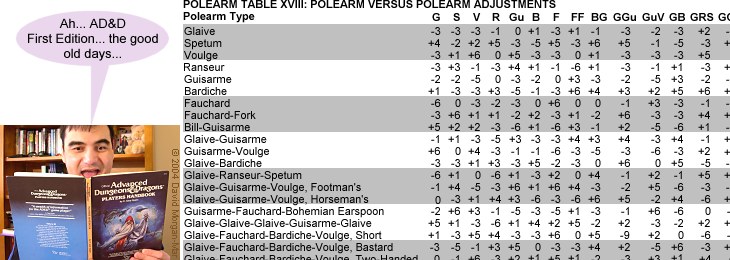
The games include these things- but that does not always reflect their importance to the game itself. The existence of the volumetric capacity table in 5e doesn't mean the designers care about how much liquid random containers can contain, they were just cargo-culting based off of the neurotic table-obsession of Gary Gygax! Tridents and pikes are in there because half of Advanced Dungeons and Dragons' weapons table was different polearms. Those things are in there because they were in ADnD and 4e was a huge failure and they needed to try and recapture that old-school magic so they just went rifling through old editions' pockets. News flash, nobody uses encumbrance! The age of the material condition has ended; the culture of play that lives upon 5e does not care about tracking lamp oil or caltrops or the exact differences between a glaive-guisarme, glaive, guisarme, and voulge-guisarme. They do not care about Material Conditions. There are fake equipment table type games and there are real ones- and the problem is that nobody even knows that these are two different genres. Maybe not even the designers.

For a brief period I thought that the equipment lists themselves were the problem. I was dissatisfied with games that didn't feel connected to the fictional reality. I didn't like that spells like Prestidigitation and Light made torches and tinderboxes useless.

This led to my spiral into the compromise, Daggerheart and Dungeon World and Pathfinder 2e. These games retain the aesthetics of materialism without the bite. Weapons are largely interchangeable props, not distinguished by their physical characteristics, but by attached gamist or narrative principles. Your character can use a Scythe as a weapon for god's sake!! They're stat sticks with microfeats baked into them! You wear armor, not because it stops daggers and arrows, but because it has "aura!" I found myself even more deeply unsatisfied by these games. You could do anything, be any kind of character, but that was simply because none of those choices mattered. Every character ended up being equally useful because every character was equally disconnected from material conditions. I didn't have to puzzle out scenarios in which my character's items and skills could be useful, because the games are tilted in such a way that basically the only things worth doing are shooting monsters in the face- something every character class and ability has been very delicately balanced around so that there are no real wrong choices.

(I actually think that these games are fun and well designed in general- but part of a genre that I do not care for.)

I could slot Narrative, Simulationist, and Gamist games into a neat continuum. Simulationist games are the most invested into material conditions, while Gamist games are only interested in the aesthetic of them. Narrative games are wholly uninterested in material conditions- or at the very least just the bare minimum required for action scenes. I'm not sure that's wholly productive though. Most games aren't strictly separable into that neat typology. 

So, why am I ranting about this? What is so important to me about Material Conditions? Well... I have a lot more to say, but this post is getting a long and I don't even know if it's a useful lens of analysis. Am I saying important things or just navel gazing? I think losing sight of material conditions leads to a loss of something essentially captivating about Dungeon type games; explaining the gradual loss of identity the "official" DnD game line has suffered- including the tragedy of the Martial/Caster divide and combat bloat. More on that later, I guess.


Saturday, January 3, 2026

Balanced game rules for your game that you play

Balance, the great and wretched altar to which I kneel. You have taken my respect, my joy my creativity. balance Balance balanace balanace balcnanlajel nbalnacen labblancnanlhe.


Power budgets and DPR and whiterooms and the END RESULT STILL FUCKING SUCKS!!!!!!!


I WORSHIPPED YOU I BELIEVED YOU I TRUSTED YOU AND ALL THE GAMES YOU GIVE ME STILL SUCK SHIT.


PF2e: SHIT GAME for SUCKERS

5e: SHIT GAME for BABIES

 3.5: SHIT GAME for IDIOTS

4e: SHIT GAME for WOW PLAYERS

WWN: SHIT GAME for 5e BABIES IN DENIAL 

 LANCER: IT"S JUST FUCKING 4e AGAIN GODDDDAMMMMITITTT 


Roll 1d12 for a cool ass weapon your wizard will never fucking use

  1. Moonblade
  2. Glaive
  3. Katana
  4. Nunchaku
  5. Miku sticker Baseball Bat
  6. The Jar
  7. Crossbow
  8. 1d4 darts
  9. Iron Spined Spellbook
  10. Dagger
  11. A staff like Gandalf from Peter Jackson
  12. Family guy dvd sharpened into a chakram
  13. A small sinew bound crossbow formed from your own flesh that fires your phalanges like bolts
  14. club
  15. blowgun (1 extra poison damage!!!!)
  16. The Throngler
  17. A trident (those are in this game?)
  18. The Pen
  19. The Sword
  20. Divorce papers


Sexmagic:

 level one: Your penis explodes

level two: Her penis explodes

level three: the cum dimension

level five: sex 2

level six: handjob 

level seven: The dao of torsion

level eight: Homosexuality

level nine: Your penis explodes \

\


 Paizo be like

PLAYABLE BEHOLDERS:

 Beholder kin are uhhh um basically just like a person but like,,,,,, imagine if ewer let you play as beholder heuh that would be so fucking sick...... youy have more yes ;:::)


+1 to all REGULAR and OCCULT spells that have the OCCULAR effect.

+1 to the RACISM skill as a RACIAL bonus

+1 to any SAVE with the TRIPWIRE or PRESSURE plate taggle, because youar FLYING but not really you can still be knocked prone and stuff but don't worry cutie pootie pinky pork pie, you still are a big sexy flying beholder

 RACial FEAT: BEHOLDERS DON't HAVE ANY FEAT THEY FLOAT


 Potions elller

NEw class


AB: Ambien
CD: Ambien

EFG: AMbien


ABCDEFG: Ambien: You take ambien and fall asleep instantly. Roll uyp a new character you piece of shit 


Power word: KILL

Powerful, EPIC, Rare, Uncommon, Necrotic, PRimal, Wisdom, ALPHA, Manipulate, incapacitate

9th level 

Walmart: onew illing creature without the SIGMA trait

range:touch

components verbal lmomatic saterial: the legs

tunch: sprunges

You call out to the primordial ether to turn your body into a turning fork for the energy of Karthassus the nihilosmic lord of killamanjaro. Choose one unwilling creature in range. It must make a fortitude saving throw or be force to make a fortitude saving throw or be forced to make a wisdom saving throw against making a reflex saving throw against a strength saving throw that would strongarm it into making an intelligence saving trhow against making a ranged touch attack with a melee spell weapon against your saving DC to make you make a ranged strenght attack its spell save dc against your touch ac against its cosmic spelggaar p ;l;sdf north of the city of wisdom or else take 3d6 plus your wisdom modifier necrotic damage. Constructs, fairies, gnomes and elves are immune to this damage. If this spell kills a creature that th DM spent mor ethan two seconds pulling out of his ass he's legally allowed to skin you alive and hang your flayed hide over his DM screen to warn everyone else away from BEING A MUNCHJKING POEWWR GAMER WHO WANTDS TO RUIN EBVERYONE"S FUN!!!